The General Weituo

(This article was published in the Shenzhen Daily on Monday, July 27, 2015.)

Weituo stands behind Mi-le Fo at Huayan Temple, Zhiti Shan

In the first hall of most temples (the "Heavenly Kings' Hall"), we are greeted by the fat, jolly figure of Mi'le Fo, the so-called "Laughing Buddha." Standing behind him there is usually an often fierce-looking warrior in armor. He is most often armed with a three-bladed sword, and he faces toward the Buddha in the main hall, away from the temple's entrance.

Jianzhen, Missionary to Japan

(This article was published in the Shenzhen Daily on August 3, 2015.)

The statue of Jianzhen at Daming Temple, Yangzhou, a gift from the Japanese

In some temples you will find images of great monks from Chinese tradition. We have already discussed Xuanzang, who went "west." Today let's look at Jianzhen, who went "east."

Puxian's Elephant

(This article was published in the Shenzhen Daily on August 10, 2015.)

A statue of Puxian and his elephant at Hongyuan Temple, Shiyan, Shenzhen

When visiting a Buddhist temple's main hall, you may notice a rather unusual creature.

The Deer and the Wheel of Dharma

(This article was published in the Shenzhen Daily on August 17, 2015.)

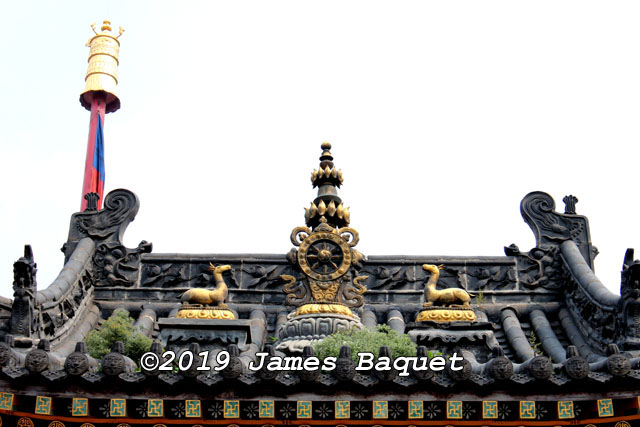
Deer and Dharma Wheel atop the gate at Shifang Tang, Wutai Shan

A lovely but enigmatic symbol sits atop the peak of many temple roofs. A large eight-spoked wheel is at the center, with two deer looking up at it with rapt attention. What does it symbolize?

The Thousand-Armed Guanyin

(This article was published in the Shenzhen Daily on Monday, August 24, 2015.)

Statue of the Thousand-Armed Guanyin at tiny Linfeng Temple, Zhiti Shan, Fujian

Perhaps the most striking statue in many Buddhist temples is also one of the most common. It is the Thousand-Armed Guanyin, usually found with eleven heads.

Ji Gong, the Eccentric Monk

(This article was published in the Shenzhen Daily on August 31, 2015.)

Ji Gong at Lingyin Temple, Hangzhou, Zhejiang

An amusing character seen in some temples is the Chan (Zen) master Ji Gong, also called Daoji. He wears a funny little hat with the character for "Buddha" on it, and monk's robes nearly in rags. His left hand holds a fan (for comfort--and magic), and in his right is a gourd containing wine. This may account for the seemingly-drunken smile on his face.

Tu Di Gong, "the Earth God"

(This article was published in the Shenzhen Daily on September 8, 2015.)

A Tu Di Gong platform under a tree in Nanshan, Shenzhen, Guangdong

One of the most ubiquitous--yet often unnoticed--of all deities is the so-called "Earth God," known in Chinese as Tu Di Gong (土地公).