Showing posts with label Symbols. Show all posts

The Deer and the Wheel of Dharma

(This article was published in the Shenzhen Daily on August 17, 2015.)
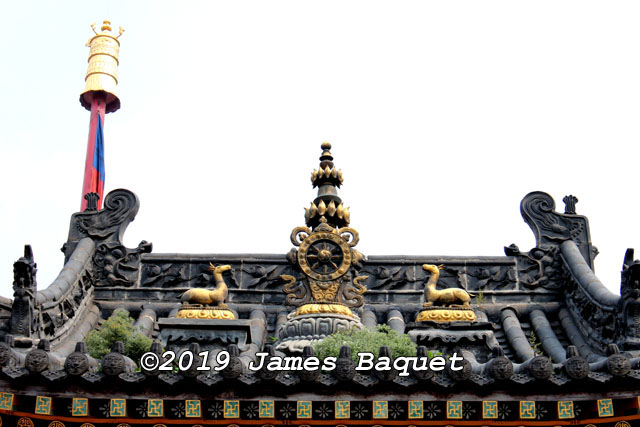
Deer and Dharma Wheel atop the gate at Shifang Tang, Wutai Shan

A lovely but enigmatic symbol sits atop the peak of many temple roofs. A large eight-spoked wheel is at the center, with two deer looking up at it with rapt attention. What does it symbolize?

The Swastika, Source of Confusion

(This article was published in the Shenzhen Daily on September 14, 2015.)

Swastika on the chest of Vairocana Buddha, Lingyin Temple, Hangzhou

For the casual Western visitor to temples, few things are more confusing than the appearance of a peculiar symbol, often in the center of a Buddha's chest.

The Pagoda and the Body of the Buddha

(This article was published in the Shenzhen Daily on October 19, 2015.)

The "Flowery Pagoda" at Liurong Temple, Guangzhou

The traditional building called the "pagoda" dates back to Buddhism's early days in India, where remains of the historical Buddha (and other significant figures) were placed in earthen mounds with a series of stylized concentric umbrellas on top, all on a single pole. (The umbrella was a symbol of royalty.)

Pillars of Ashoka

(This article was published in the Shenzhen Daily on December 21, 2015.)

The Pillar of Ashoka at Jing'an Temple, Shanghai

Ashoka, king of the Mauryan Empire (322 to 185 BCE), ruled most of what is modern India, including the area where the historical Buddha had been active about three centuries before.

Amitabha and the Lotus

(This article was published in the Shenzhen Daily on January 4, 2016.)

Amitabha Buddha at Longhua Temple, Shanghai

In many temples, you'll find three Buddhas on the main altar: the historical Buddha Shakyamuni at the center; on our right the Medicine Buddha; and on our left the most popular Buddha in China, the Amitabha Buddha, called in Chinese Amitofo.

The Buddha's Footprints

(This article was published in the Shenzhen Daily on January 18, 2016.)

The Buddha's footprints on a stele at Wolong Temple, Xi'an

When writing about the Wheel of Dharma, I mentioned that earlier Buddhists were reluctant to represent the Buddha in human form, considering it to be disrespectful. Thus the artists turned to aniconic ("without icon" or "image") representations of the Buddha--that is, images without human figures.

Guanyin and Amitabha

(This article was published in the Shenzhen Daily on January 25, 2016.)

Head of Guanyin with Amitabha in headdress, Longhua Temple, Shanghai

Iconography is a key aspect of the study of any religion. This is the symbolism used to represent key figures, and help us identify one from the other. In Buddhism, for example, where all Buddhas mostly look alike, only certain gestures (called mudras), or implements (like a pagoda or a lotus), distinguish one from another.

The Character for "Buddha"

(This article was published in the Shenzhen Daily on February 1, 2016.)

The character for "Buddha" on a mended tree at Tiantong Temple, Ningbo, Zhejiang 

Two Chinese characters are commonly seen when visiting temples in China. One is the character for "Chan" (Zen), usually seen on a banner in front of the Chan Hall. The other is the character for "Buddha." Let's look at that today.

Prayer Wheels

(This article was published in the Shenzhen Daily on February 15, 2016.)

Prayer wheels at Guangren Temple, Xi'an

The tradition I have most thoroughly studied is Han Buddhism, which is practiced throughout the area of China that has historically been occupied by the majority Han ethnicity. There are actually two other Buddhist traditions found in China: the Theravada (similar to that found in South Asia) and the Tibetan.

Lotus Lore

(This article was published in the Shenzhen Daily on September 26, 2016.)

Lotus flowers at Longxing Temple, Zhengding (Shijiazhuang), Hebei

The lotus is preeminently the flower of Buddhism. I have spent hours gazing at lotus ponds in temples in Japan and China, and have come to love their symbolism.