Showing posts with label Guangzhou. Show all posts

Birth of the Buddha

(This article was published in the Shenzhen Daily on June 15, 2015.)

Nine dragons bathe the Baby Buddha in front of Dongshan Temple, Dapeng, Shenzhen

The story of Buddhism begins with the historic Buddha, sometimes known in China as "Ben Shi" (本师)--"Original Teacher" or "Founder." And of course, his story begins with his birth.

Buddhas of the Three Times

(This article was published in the Shenzhen Daily on July 20, 2015.)

Buddhas of the Three Times at Liurong Temple, Guangzhou

The main hall of some temples is called the "Precious Hall of the Great Hero," which refers to Shakyamuni, the historic Buddha. He is usually seated with figures on either side of him--bodhisattvas, or other Buddhas.

The Three Star Gods: Fu, Lu, and Shou

(This article was published in the Shenzhen Daily on September 21, 2015.)

Fu, Lu, and Shou (R to L) at San Yuan Gong, Guangzhou

You might see three strange-looking men on a table somewhere in a Daoist folk temple, or they may be painted on a wall. One looks like a scholar; another wears the headpiece of a high government official; and the third has an oddly bulging forehead. These are the three deities known together as "Fu Lu Shou," said to be the earthly manifestations of three "stars" (one is actually a planet) and representing aspects of a good life.

The Five Immortals and Five Rams of Guangzhou

(This article was published in the Shenzhen Daily on September 28, 2015.)

The Five Rams Statue in Yuexiu Park, Guangzhou

At the heart of Guangzhou's Yuexiu Park stands a statue of five goats or rams. The story goes like this:

The Chan Hall

(This article was published in the Shenzhen Daily on June 20, 2016.)

The Chan Hall at Guangxiao Temple, Guangzhou

Many temples have a chan tang (Japanese zendo) or Meditation Hall. Those temples that do not have a separate hall usually have benches around the sides of the main hall for sitting.

What is "Zen"? (Part I)

(This article was published in the Shenzhen Daily on September 5, 2016.)

The character for "Chan" on a wall at Wolong Temple, Xi'an

At many temples in China, there is a special hall set aside for meditation. In Chinese, the practice is referred to as "Chan."

Jubo and Xiqing Arhats

(This article was published in the Shenzhen Daily on November 21, 2016.)

Jubo Arhat at Huayan Temple, Datong, Shanxi Province

The next two Arhats in our survey of the famous eighteen are Jubo and Xiqing, the "Bowl Raising" and "Festive" Arhats.

He Xiangu, Immortal

(This article was published in the Shenzhen Daily on February 13, 2017.)

A bas relief of He Xiangu with a flower in her
hair at the Tianhou Palace in Chiwan, Shenzhen

He Xiangu is the only one of the Eight Immortals who is unambiguously a woman. (We will come to understand this better next time.) She is usually seen holding a basket of flowers which in fact (though not in pictures!) has no bottom and no edges, and could hold all of the world's flowers and grasses and still have room for more. Other times she holds a lotus, or a musical instrument. It is said she was born in the Zengcheng District of Guangzhou, during the Tang Dynasty.

Huineng Gets Ordained

(This article was published in the Shenzhen Daily on April 24, 2017.)

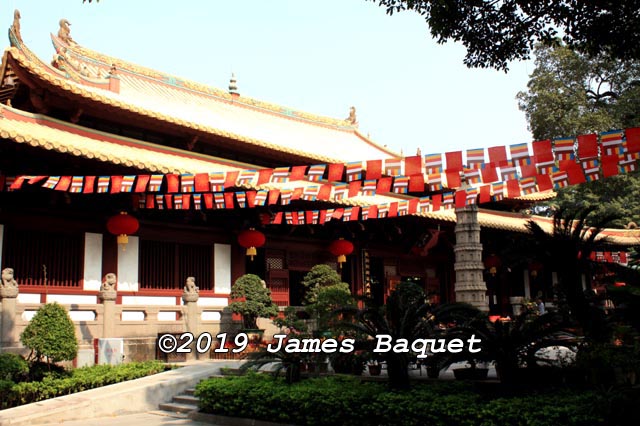
The grounds of Guangxiao Temple are festooned with flags to memorialize Huineng's famous utterance.

Last time we talked about how Huineng won a poetry contest and became the Sixth Patriarch.

Bodhidharma, First Chan Patriarch

(This article was published in the Shenzhen Daily on May 29, 2017.)

A statue of Bodhidharma at Hualin Temple,
Guangzhou, where he first stayed in China

Few figures in Chinese Buddhism have captivated the popular imagination like Bodhidharma, said to be the First Patriarch of Chan (Zen) in China, but the 28th in direct descent from the Buddha and his immediate disciple, Mahakashyapa, back in India.