Showing posts with label Chan. Show all posts

Amitabha and the Lotus

(This article was published in the Shenzhen Daily on January 4, 2016.)

Amitabha Buddha at Longhua Temple, Shanghai

In many temples, you'll find three Buddhas on the main altar: the historical Buddha Shakyamuni at the center; on our right the Medicine Buddha; and on our left the most popular Buddha in China, the Amitabha Buddha, called in Chinese Amitofo.

Ananda and Kashyapa

(This article was published in the Shenzhen Daily on February 22, 2016.)

Ananda and Kashyapa flank the Buddha at Hongyuan Temple, Shenzhen

When the Buddha is on a temple's main altar, there are often two seated figures of similar size on either side. These may be other Buddhas, or various bodhisattvas.

The Chan Hall

(This article was published in the Shenzhen Daily on June 20, 2016.)

The Chan Hall at Guangxiao Temple, Guangzhou

Many temples have a chan tang (Japanese zendo) or Meditation Hall. Those temples that do not have a separate hall usually have benches around the sides of the main hall for sitting.

The Patriarchs' Hall

(This article was published in the Shenzhen Daily on July 11, 2016.)

Inside the Patriarchs' Hall at Linji Temple, Zhengding, Hebei

Many temples will have a "Patriarch's Hall," recognizing the temple's forebears.

Huineng's "Refuge Rock"

(This article was published in the Shenzhen Daily on August 15, 2016.)

Marks in the niche in "Refuge Rock" said to be made by Huineng's robe

Including some areas to its north and south, Shaoguan in Guangdong is "Huineng Country." The Sixth Patriarch was born and died south of Zhaoqing, and was ordained at the Fifth Patriarch's temple in Huangmei County, Hubei. Shaoguan lies between the two.

What is "Zen"? (Part I)

(This article was published in the Shenzhen Daily on September 5, 2016.)

The character for "Chan" on a wall at Wolong Temple, Xi'an

At many temples in China, there is a special hall set aside for meditation. In Chinese, the practice is referred to as "Chan."

What is "Zen"? (Part II)

(This article was published in the Shenzhen Daily on September 12, 2016.)

Summer flowers at Jinge Temple, Mt. Wutai,
remind us of the impermanence of things.

Last time we talked a little about Bodhidharma, first patriarch of Chan (Zen) in China, and 28th from the beginnings in India. And we mentioned that that tradition began in India with Mahakashyapa.

Huineng and the Poetry Competition

(This article was published in the Shenzhen Daily on April 17, 2017.)

The grand new gateway to the ancient Wuzu Temple, Huangmei, Hubei

Huineng, the Sixth Patriarch, was born, taught, and died within a relatively short distance of Guangzhou. In fact, only one major event of his life took place outside of Guangdong Province, and that was in the remote Huangmei Mountains of Hubei.

Huineng Gets Ordained

(This article was published in the Shenzhen Daily on April 24, 2017.)

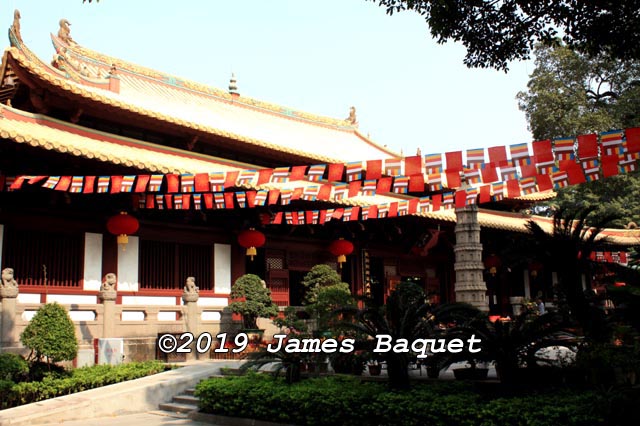
The grounds of Guangxiao Temple are festooned with flags to memorialize Huineng's famous utterance.

Last time we talked about how Huineng won a poetry contest and became the Sixth Patriarch.

Bodhidharma, First Chan Patriarch

(This article was published in the Shenzhen Daily on May 29, 2017.)

A statue of Bodhidharma at Hualin Temple,
Guangzhou, where he first stayed in China

Few figures in Chinese Buddhism have captivated the popular imagination like Bodhidharma, said to be the First Patriarch of Chan (Zen) in China, but the 28th in direct descent from the Buddha and his immediate disciple, Mahakashyapa, back in India.

Huike, the Second Chan Patriarch

(This article was published in the Shenzhen Daily on June 5, 2017.)

The modern Erzu Temple at the foot of Sikong Mountain

Bodhidharma's successor has no less dramatic a story than the First Patriarch himself.

Master Xuyun

(This article was published in the Shenzhen Daily on June 12, 2017.)

Statue of Xuyun at Yunmen Temple, Guangdong

Perhaps the greatest Buddhist Master of the 19th and 20th centuries was the monk called Xuyun ("Empty Cloud"). From Quanzhou to Kunming, and especially around northern Guangdong, it is hard to find a major temple untouched by his efforts.

At the Feet of Master Ji Qun

(This article was published in the Shenzhen Daily on June 26, 2017.)

Master Ji Qun goes over notes outside a hermitage near Huayan Temple, Ningde, Fujian

In the summer of 2006, I had the extraordinary opportunity to spend a week in a remote mountain temple, teaching Buddhism in English to about 100 kids. There I met a great Master who also joined us in teaching the students.

More Wisdom from Master Ji Qun

(This article was published in the Shenzhen Daily on July 3, 2017.)

Master Ji Qun leaving the hermitage near Huayan Temple, Ningde, Fujian

Last time I talked about meeting Master Ji Qun, Abbot of the Xiyuan Temple in Suzhou. We met in a mountain hermitage near Huayan Temple on Zhiti Mountain, where I had been teaching English to about 100 kids, and he was there sharing his deep wisdom.