Showing posts with label Amitabha. Show all posts

Amitabha and the Lotus

(This article was published in the Shenzhen Daily on January 4, 2016.)

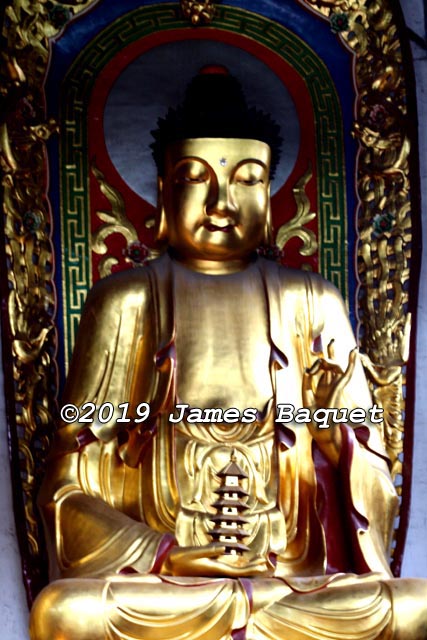
Amitabha Buddha at Longhua Temple, Shanghai

In many temples, you'll find three Buddhas on the main altar: the historical Buddha Shakyamuni at the center; on our right the Medicine Buddha; and on our left the most popular Buddha in China, the Amitabha Buddha, called in Chinese Amitofo.

Guanyin and Amitabha

(This article was published in the Shenzhen Daily on January 25, 2016.)

Head of Guanyin with Amitabha in headdress, Longhua Temple, Shanghai

Iconography is a key aspect of the study of any religion. This is the symbolism used to represent key figures, and help us identify one from the other. In Buddhism, for example, where all Buddhas mostly look alike, only certain gestures (called mudras), or implements (like a pagoda or a lotus), distinguish one from another.

The Altar in the Main Hall

(This article was published in the Shenzhen Daily on May 2, 2016.)

Left to right: Amitofo with a lotus; Shakyamuni flanked by Ananda and Kashyapa;
and the Medicine Buddha with a pagoda, at tiny Youmin Temple, Nanchang, Jiangxi

A temple's main hall may have various names. In most temples, the figure seated at the center of the altar will be the historic Buddha, Shakyamuni, so the hall is called the "Precious Hall of the Great Hero" (Daxiong Baodian). This is sometimes translated "Mahavira Hall" ("Mahavira" is Sanskrit for "Great Man" or "Hero"), but this can be confused with the proper name of one of the great leaders of the Jains, who lived in India around the same time as the Buddha.

Outside the Main Courtyard

(This article was published in the Shenzhen Daily on May 30, 2016.)

An island in the West Garden's small lake, Daming Temple, Yangzhou

Outside of the temple's main compound there are other features. Many temples have a West Garden, an earthly representation of the Amitabha Buddha's Western Pure Land.

The Three Sages of the West

(This article was published in the Shenzhen Daily on June 13, 2016.)

This ornate set of the Three Sages stands in a side hall at Linggu Temple, Nanjing

A temple visitor might encounter a set of three figures in its own hall outside of the main compound. These are the "Three Sages of the West," alternately called "Saints" instead of "Sages."

Lingshan Scenic Area, Wuxi

(This article was published in the Shenzhen Daily on Oct 10, 2016.)

The Great Buddha at Lingshan Scenic Area

In January of 2012 I was privileged to be invited to speak at the installation of the new abbot at Kaiyuan Temple in Wuxi. He had formerly been my student at a Buddhist academy, and wanted international representatives on his Big Day.

Eleven-Headed Guanyin

(This article was published in the Shenzhen Daily on Sep 11, 2017.)

Guanyin with eleven heads and "1,000" arms at Dongshan Temple, Shenzhen

A bodhisattva is one whose being (sattva) is enlightened (bodhi). Astute readers may see that the consonants in bodhi--b, d, h--are shared by the word buddha, which means "one who is enlightened." But a bodhisattva differs from a buddha in that, although he or she has worked his/her way up to enlightenment, he/she has vowed to stop short of nirvana until all beings become enlightened. (Never mind that Mahayana followers believe that Buddhas are still available to help as well.)

The Medicine Buddha

(This article was written for, but never published in, the Shenzhen Daily.)

The Medicine Buddha at Nanhua Temple, Shaoguan, Guangdong

In many temples, the Main Altar is graced by three Buddhas: the historic Shakyamuni Buddha in the center; the very popular Amitabha Buddha (Amito Fo) on the viewer's left; and the Medicine Buddha (Yaoshi Fo) on the right. Though certainly not as well known as the other two, this last has his own special cult of devotion.