Showing posts with label Bhaisajyaguru. Show all posts

The Pagoda and the Body of the Buddha

(This article was published in the Shenzhen Daily on October 19, 2015.)

The "Flowery Pagoda" at Liurong Temple, Guangzhou

The traditional building called the "pagoda" dates back to Buddhism's early days in India, where remains of the historical Buddha (and other significant figures) were placed in earthen mounds with a series of stylized concentric umbrellas on top, all on a single pole. (The umbrella was a symbol of royalty.)

Amitabha and the Lotus

(This article was published in the Shenzhen Daily on January 4, 2016.)

Amitabha Buddha at Longhua Temple, Shanghai

In many temples, you'll find three Buddhas on the main altar: the historical Buddha Shakyamuni at the center; on our right the Medicine Buddha; and on our left the most popular Buddha in China, the Amitabha Buddha, called in Chinese Amitofo.

The Altar in the Main Hall

(This article was published in the Shenzhen Daily on May 2, 2016.)

Left to right: Amitofo with a lotus; Shakyamuni flanked by Ananda and Kashyapa;
and the Medicine Buddha with a pagoda, at tiny Youmin Temple, Nanchang, Jiangxi

A temple's main hall may have various names. In most temples, the figure seated at the center of the altar will be the historic Buddha, Shakyamuni, so the hall is called the "Precious Hall of the Great Hero" (Daxiong Baodian). This is sometimes translated "Mahavira Hall" ("Mahavira" is Sanskrit for "Great Man" or "Hero"), but this can be confused with the proper name of one of the great leaders of the Jains, who lived in India around the same time as the Buddha.

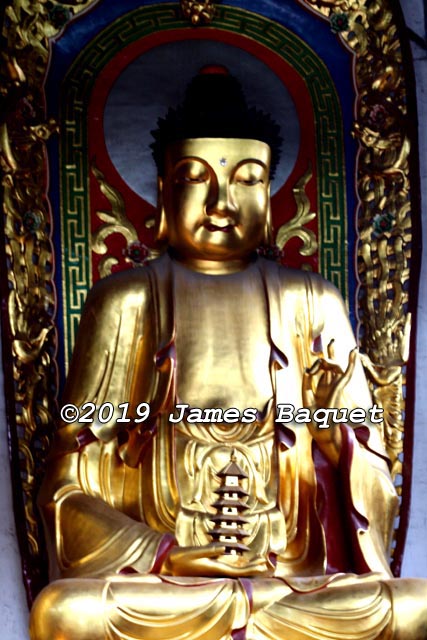
The Medicine Buddha

(This article was written for, but never published in, the Shenzhen Daily.)

The Medicine Buddha at Nanhua Temple, Shaoguan, Guangdong

In many temples, the Main Altar is graced by three Buddhas: the historic Shakyamuni Buddha in the center; the very popular Amitabha Buddha (Amito Fo) on the viewer's left; and the Medicine Buddha (Yaoshi Fo) on the right. Though certainly not as well known as the other two, this last has his own special cult of devotion.